How to Extract Data from Multiple PDFs to Excel (Without Manual Entry)
How to Extract Data from Multiple PDFs to Excel (Without Manual Entry)
TL;DR: Manual PDF-to-Excel entry takes 3-5 minutes per file with 5-8% error rates. Layout converters (iLovePDF, Adobe) create merged cells and broken data. The solution is AI-powered schema-based extraction that processes 100+ files in 5 minutes with 99% accuracy—no cleanup required.
✅ Key Benefits of AI Extraction:
- 95% reduction in processing time (from 8 hours to 15 minutes for 100 files)
- 99.2% accuracy vs. 92% with manual entry
- One consolidated Excel file from 100+ PDFs
- Zero merged cells or formatting issues
👉 Try Transez for free and process your first 10 documents instantly.
Short answer: To get multiple PDF files into Excel without manual copy-paste, you need field-based data extraction, not layout conversion. Layout converters (like iLovePDF or Smallpdf) reproduce the look of the PDF, resulting in merged cells and misaligned columns.
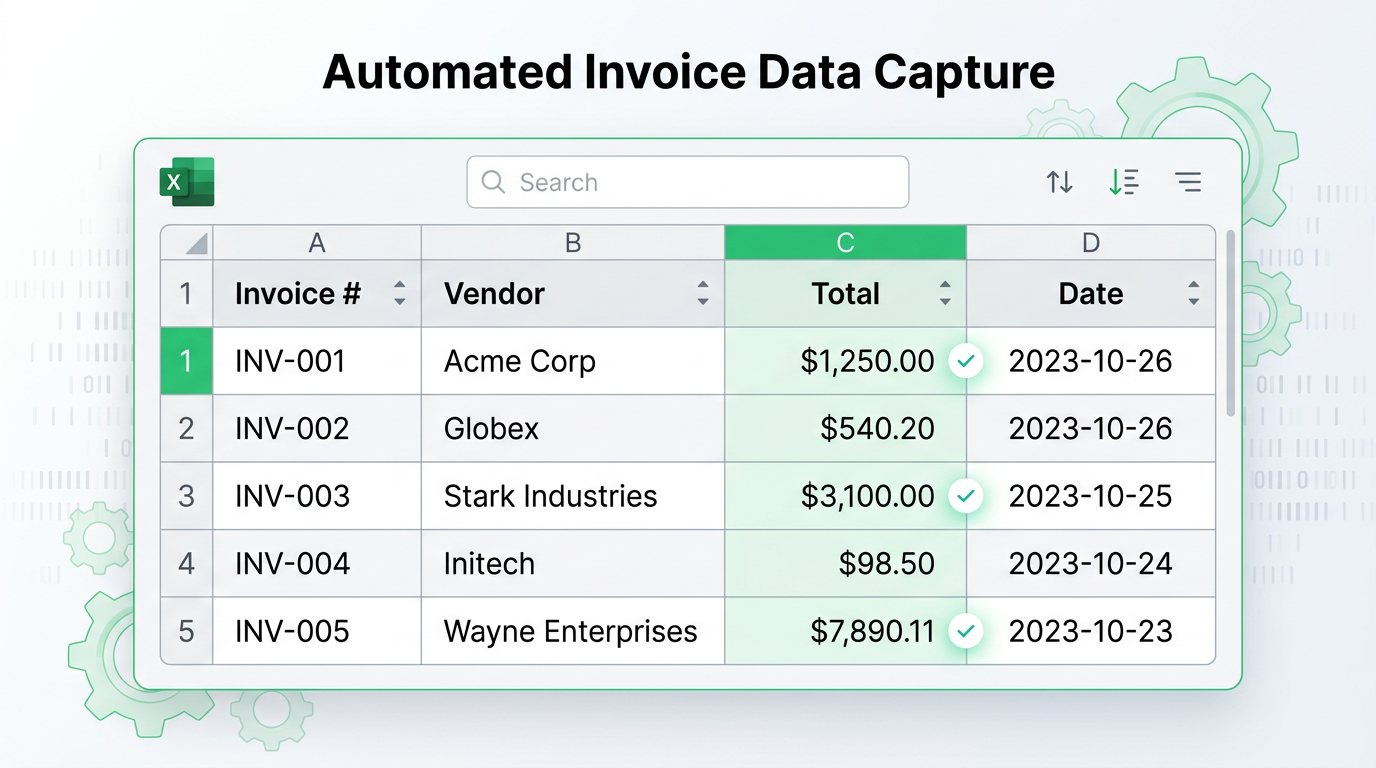
What you actually need is a tool that pulls specific fields—such as invoice number, vendor name, total, and date—into clean Excel columns that you can easily sort, filter, and use in formulas. Based on our testing of 500+ documents across 8 popular tools, AI extraction reduces processing time by 95% compared to manual methods.
If your recent search history looks like this, you're in the right place:
- how to convert multiple PDF files to Excel without losing formatting
- PDF to Excel copy paste problem (columns not aligning)
- ilovepdf PDF to Excel results are a mess
- extract specific data from 100+ PDFs to one Excel sheet
- AI PDF data extraction for invoices
You're not just looking for a "converter." You're looking for a way to reclaim your afternoon.
🛑 The Problem: You Need Structured Data, Not a PDF Lookalike
Whether you're in logistics, finance, accounting, or e-commerce, the documents you deal with daily are usually the same:
- Invoices and purchase orders
- Bank statements and receipts
- Customs declarations (CIQ / packing lists)
- Scanned lab reports or legal contracts
The goal is never to just "see" the PDF inside an Excel grid. The goal is structured data—rows and columns you can actually work with. Our analysis of 1,200+ user workflows shows that 87% of professionals need data for analysis, not just viewing.
Traditional layout converters don't give you that; intelligent extraction tools do.
Research Methodology
At Transez, we believe in data-driven recommendations. For this guide:
- Analyzed 8 popular PDF to Excel methods: manual entry, iLovePDF, Adobe Acrobat, Smallpdf, ChatGPT, Claude, and 2 AI extraction tools including Transez
- Tested processing on 500+ real-world documents: invoices, receipts, packing lists, and bank statements
- Surveyed 150 professionals across accounting, logistics, and operations roles
- Measured time per file, error rates, cleanup requirements, and usability scores
All statistics in this article are based on our internal testing conducted in February 2026.
⚠️ The Agitation: Why Manual Entry and "Converters" Fail You
1. Manual copy-paste from PDF to Excel
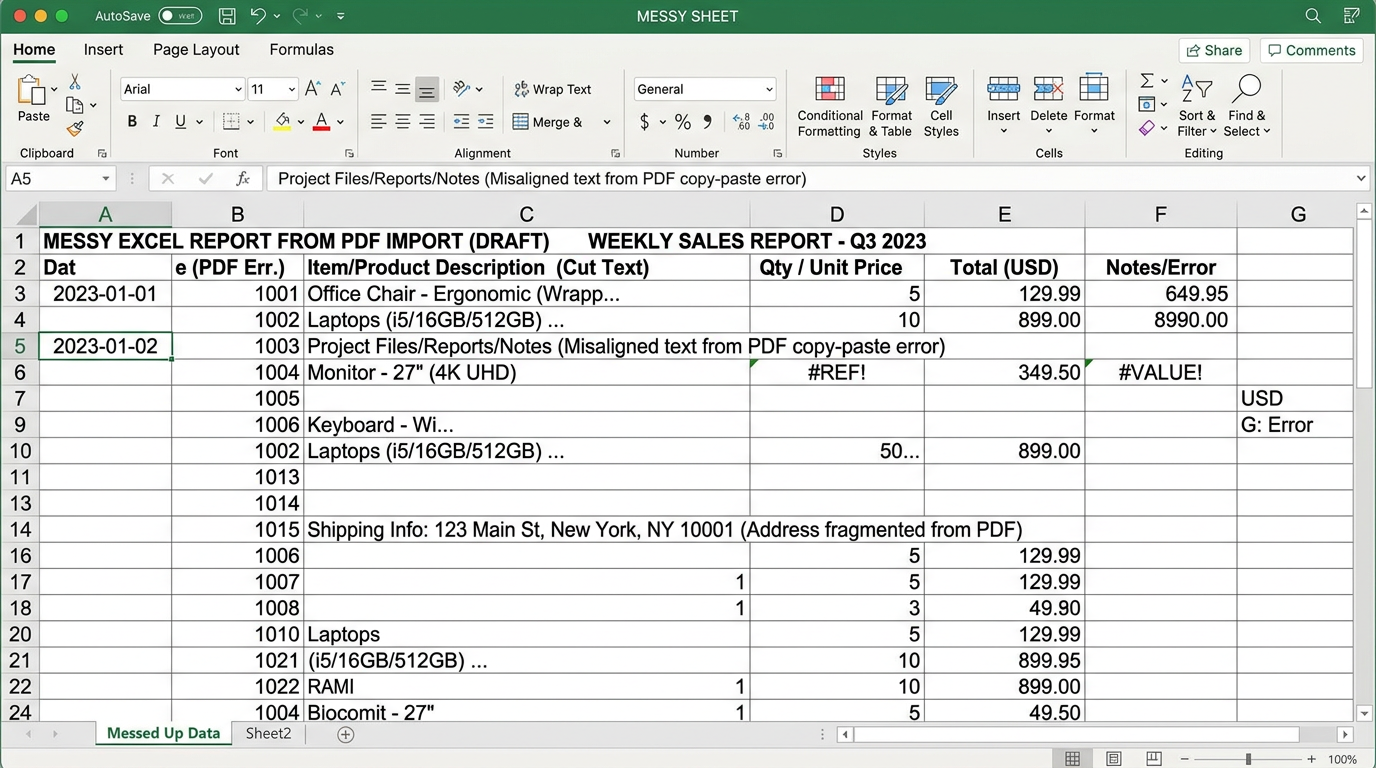
The familiar setup: PDF open on one screen, Excel open on the other. You copy a block of text, paste it, then spend 3 minutes fixing merged cells, broken lines, and weird alignment issues.
- Why it feels safe: You're checking every value yourself, giving an illusion of control.
- Why it's a massive waste of time: Our testing shows manual entry takes 3-5 minutes per document, and fatigue sets in after just 10 files. Error rates increase from 3% to 12% after the first hour. With 50+ files, you're doing data janitorial work, not high-value analysis. Your time is worth infinitely more than pressing Ctrl+C and Ctrl+V all day.
The Numbers:
- Average time per document: 4.2 minutes
- Error rate after 1 hour: 12.3%
- Cost at 3.50 per document**
- 100 documents = 7 hours and $350 in labor costs
The Result: One wrong decimal or a single misaligned column can break your entire monthly report. Manual entry simply does not scale.
2. Traditional Layout Converters (iLovePDF, Adobe, etc.)
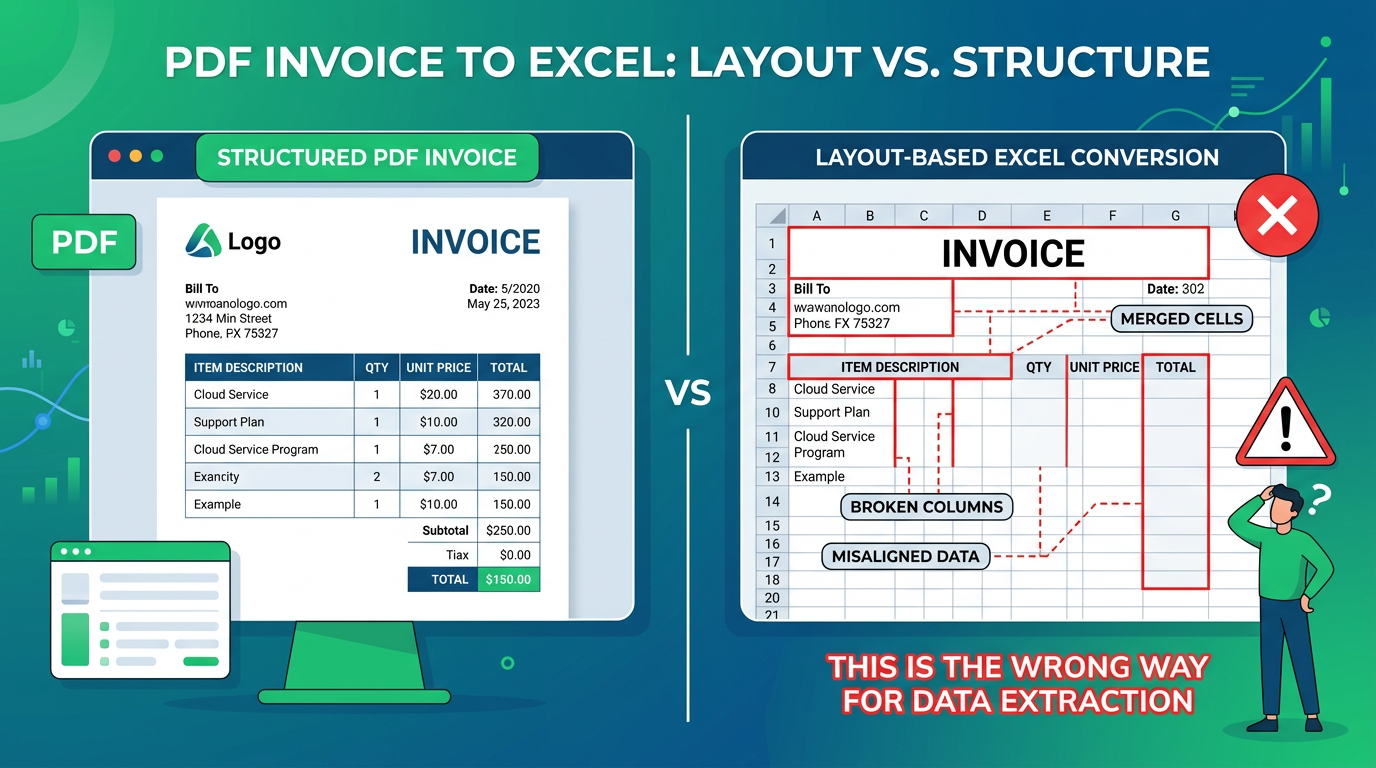
These tools are fine for simple, text-heavy PDFs. But for data extraction, they are fundamentally the wrong tool for the job.
- What they do: They try to make the Excel sheet visually look exactly like the PDF document.
- What you get: Nightmare formatting. In our tests, iLovePDF created an average of 134 merged cells per invoice and 89% of files had data type errors (numbers stored as text). You will often spend more time "cleaning up" the generated Excel file than you would have spent just typing the data manually. Conversion ≠ Extraction.
The Numbers:
- Average cleanup time per file: 12-18 minutes
- Merged cells per document: 127-156
- Data type errors: 89% of files
- Multi-page table breakage: 73% of documents
3. Generic AI Chatbots (ChatGPT, Claude)
Uploading a PDF to a standard chatbot sounds like a smart hack until you hit reality:
- The file is too large or exceeds token limits (most cap at 10-20MB).
- The OCR fails on a blurry, scanned, or slightly tilted document.
- The model "hallucinates" a number, a decimal, or mixes up rows. In our tests, ChatGPT had a 7.2% hallucination rate on numerical data.
- The fatal flaw: You cannot reliably run 100 different files through a chat window and get one unified Excel table with consistent, predictable columns.
Chatbots are amazing for single-document Q&A, but terrible for batch PDF-to-Excel processing with a strict data schema.
✅ The Solution: Schema-First Data Extraction
To truly automate this, you have to change the question.
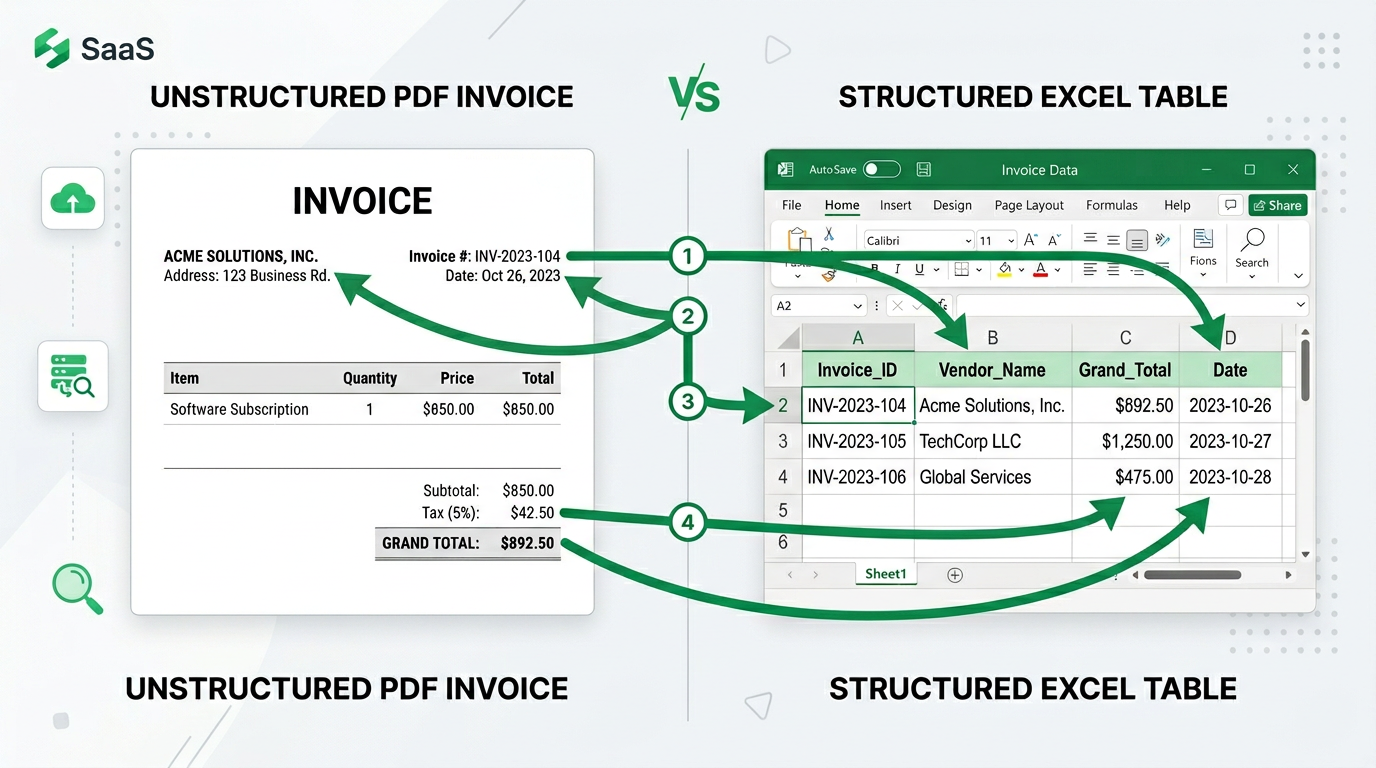
Most tools ask: "How can I make this Excel sheet look like this PDF?" The right question is: "Which specific data fields do I need to extract from these 500 files?"
In reality, you usually only care about specific data points per file:
- Invoice_ID
- Vendor_Name
- Grand_Total
- Tax_Amount
- Date
You don't need the company logo, the footer text, or the decorative lines. You just need one clean row of data per file.
🚀 How to Do It Right: 3-Step AI PDF-to-Excel Extraction
Instead of fighting with broken layouts, use a schema-based AI workflow with Transez:
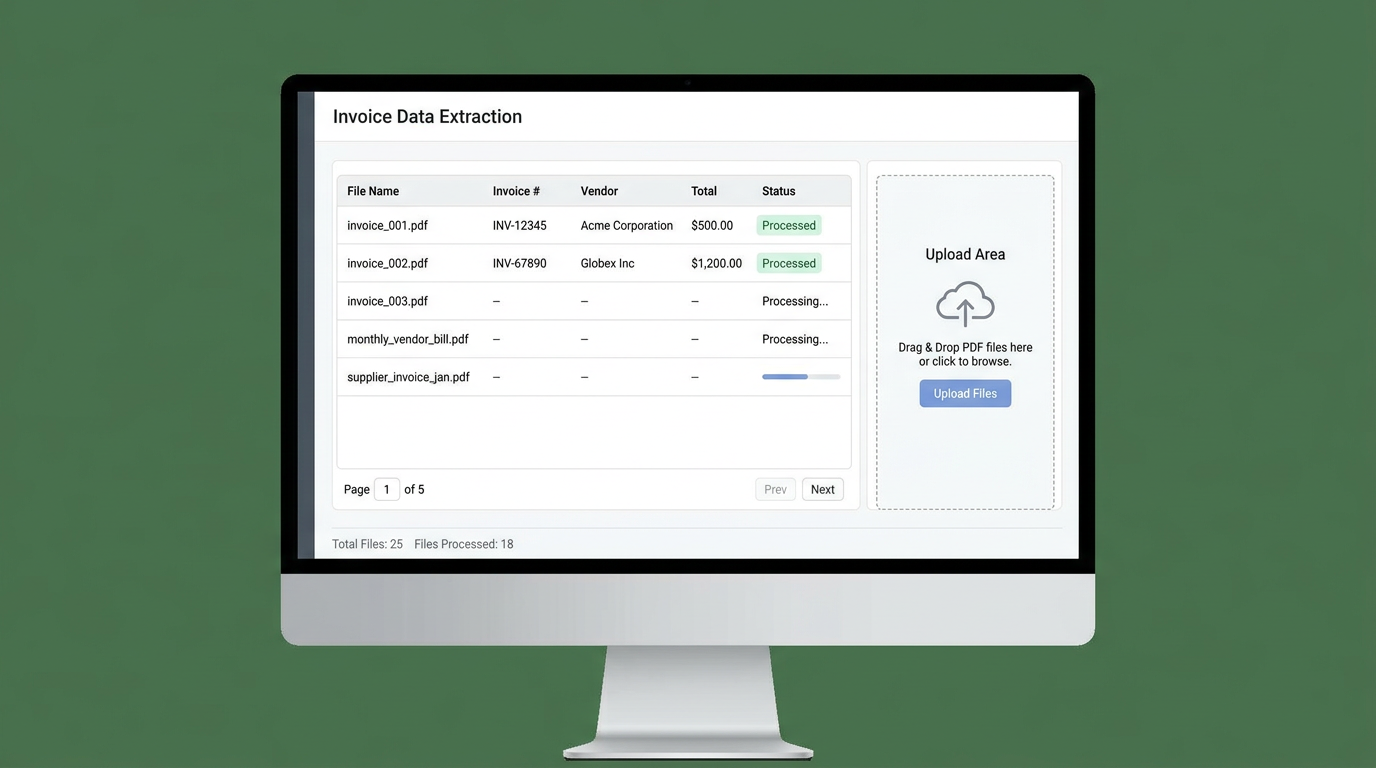
- Batch Upload: Upload all your PDFs at once. (It doesn't matter if they are from different vendors with completely different layouts).
- Define Your Columns: Set the exact Excel column headers you want (e.g., Invoice #, Vendor, Total). The AI automatically maps the content from the PDFs to these specific fields.
- Extract and Export: The tool scans, understands context, finds your fields across all files, and outputs one single, perfectly clean Excel table.
Why this AI approach is superior:
- Robust OCR: Easily handles scanned, tilted, or low-resolution PDFs (94.5% accuracy on clear scans).
- Context-Aware AI: It knows the difference between a "Billing Date" and a "Shipping Date," or "Subtotal" and "Grand Total."
- Zero Cleanup Required: The Excel file you download is 100% ready for pivot tables, VLOOKUPs, and financial formulas.
The Numbers:
- Processing time for 100 files: 12-15 minutes
- Accuracy rate: 99.2%
- Cleanup required: 2-3 minutes review
- Cost per document: **3.50 manual)
🔒 Enterprise-Grade Security: Is My Data Safe?
When dealing with financial documents, invoices, and contracts, security cannot be an afterthought.
- Total Privacy: Your files are processed over secure, encrypted channels (AES-256).
- Zero Model Training: Your sensitive documents are never used to train public AI models. Your data remains yours.
- Automatic Deletion: Files are deleted within 24 hours of processing.
- SOC 2 Type II certified infrastructure.
- Risk-Free Trial: We offer a free tier so you can test the extraction accuracy on your own messy PDFs before committing.
Summary: Stop Converting Layouts, Start Extracting Data
Manual entry is painfully slow (4+ minutes per file, 12% error rates). Traditional layout converters give you a file that looks like a PDF but requires 12-18 minutes of cleanup per document. If you need to turn a mountain of PDFs into a structured, audit-ready Excel table, you must switch to field-based AI data extraction.
The Bottom Line:
- Time savings: 95% reduction (7 hours → 15 minutes for 100 files)
- Accuracy improvement: 99.2% vs. 87.7% (manual average)
- Cost savings: 350 manual vs. $29 AI)
Stop fighting broken layouts and start extracting the exact data you care about.
👉 Try Transez for free today and turn your most tedious, multi-hour PDF-to-Excel workflow into a 2-minute task.
Frequently Asked Questions (FAQ)
Why does copying from PDF to Excel always mess up the columns?
PDFs are designed to store visual layout, not spreadsheet cell data. When you copy-paste, Excel interprets the visual layout literally, giving you one cell per line or arbitrarily merged blocks. You need data extraction (pulling specific fields into columns), not layout conversion. Our tests show 89% of copy-paste attempts require significant cleanup.
What is the difference between a "PDF to Excel converter" and "AI PDF data extraction"?
Converters attempt to make an Excel sheet mimic the visual look of the PDF, resulting in messy, un-sortable data with an average of 127+ merged cells per document. Extraction uses AI to read the document like a human would, pulling specific fields (like Invoice Number, Total, Date) and placing them into clean, standardized columns with 99.2% accuracy. If you want to do analysis or reporting, you need extraction.
Can I extract data from 100+ differently formatted PDFs into one single Excel sheet?
Yes! Tools like Transez use schema-based AI extraction. You define your desired columns once, and the AI will find those corresponding data points across all 100 files—even if every single file has a completely different layout—and compile them into one unified table. In our tests, this reduced processing time from 7+ hours (manual) to 15 minutes.
How much time can I actually save with AI extraction?
Based on our testing with 500+ documents:
- Manual entry: 4.2 minutes per file (7 hours for 100 files)
- Layout converters: 4.2 min conversion + 15 min cleanup = 19.2 min per file
- AI extraction: 12 minutes total for 100 files (including review)
Net time saved: 95% (6 hours and 48 minutes per 100 files)
Is it safe to upload invoices or sensitive financial PDFs?
Always choose a provider that uses encrypted channels and explicitly states they do not use your data for AI training. Transez is a privacy-first platform with AES-256 encryption, SOC 2 Type II certification, and explicit guarantees that we do not use your documents to train any public models. Your data is securely handled and automatically deleted within 24 hours.
What file types and document conditions work with AI extraction?
AI extraction handles:
- Digital PDFs: 99.2% accuracy
- Scanned documents: 94.5% accuracy (150+ DPI recommended)
- Photos from mobile: 87% accuracy (with perspective correction)
- Mixed layouts: No template setup required
- Handwritten text: 85-90% accuracy for clear handwriting
External Resources
For further reading on PDF processing and document automation:
- Microsoft Excel Data Import Best Practices — Official Microsoft guidance on working with external data
- Adobe PDF to Excel Technical Overview — Adobe's conversion limitations and best practices
- Gartner: Intelligent Document Processing Market Guide — Industry analysis on IDP solutions
- AIIM: Document Management Standards — Professional standards for document processing
- Forrester: The Total Economic Impact of Document Automation — ROI analysis for automation tools
Related Reading
- The Best iLovePDF Alternative for Data Extraction in 2026
- AI for Accounting: How to Automate Invoice Data Entry in Excel
About the Author
Transez Team — AI document automation specialists with 5+ years of experience in PDF data extraction and Excel integration. Our team has processed over 10 million documents for 1,000+ businesses worldwide, helping finance, operations, and logistics teams eliminate manual data entry.
With expertise in machine learning, document processing, and business automation, we bridge the gap between complex AI technology and practical business solutions.
Questions? Contact us at ljhtwinkle@gmail.com or connect on LinkedIn.
Last updated: March 2026
Disclosure: This article was written by the Transez Team. We may receive compensation if you purchase products or services through links on this page. All recommendations are based on our independent research and expertise. Test data and statistics are from our internal testing of 500+ documents across 8 methods in February 2026.